
!!!🤖WIP Working in Progress🤖!!! In order to meet academic integrity requirements, I am sorry to not accept any Issue and Pull Request (PR) until July.
English | 简体中文
TelePath (Telepathy, Telemetry + Path) is a research-oriented C++17 SDK for building an observable buffer pool and page cache engine for modern storage environments.
It is not intended to be a full DBMS. The project is scoped as a reusable systems library with:
- a concurrent buffer pool core,
- pluggable replacement policies,
- a stable POSIX fallback backend,
- a native
io_uringbackend path for supported Linux environments, - a low-overhead telemetry interface designed to stay off the hot path.
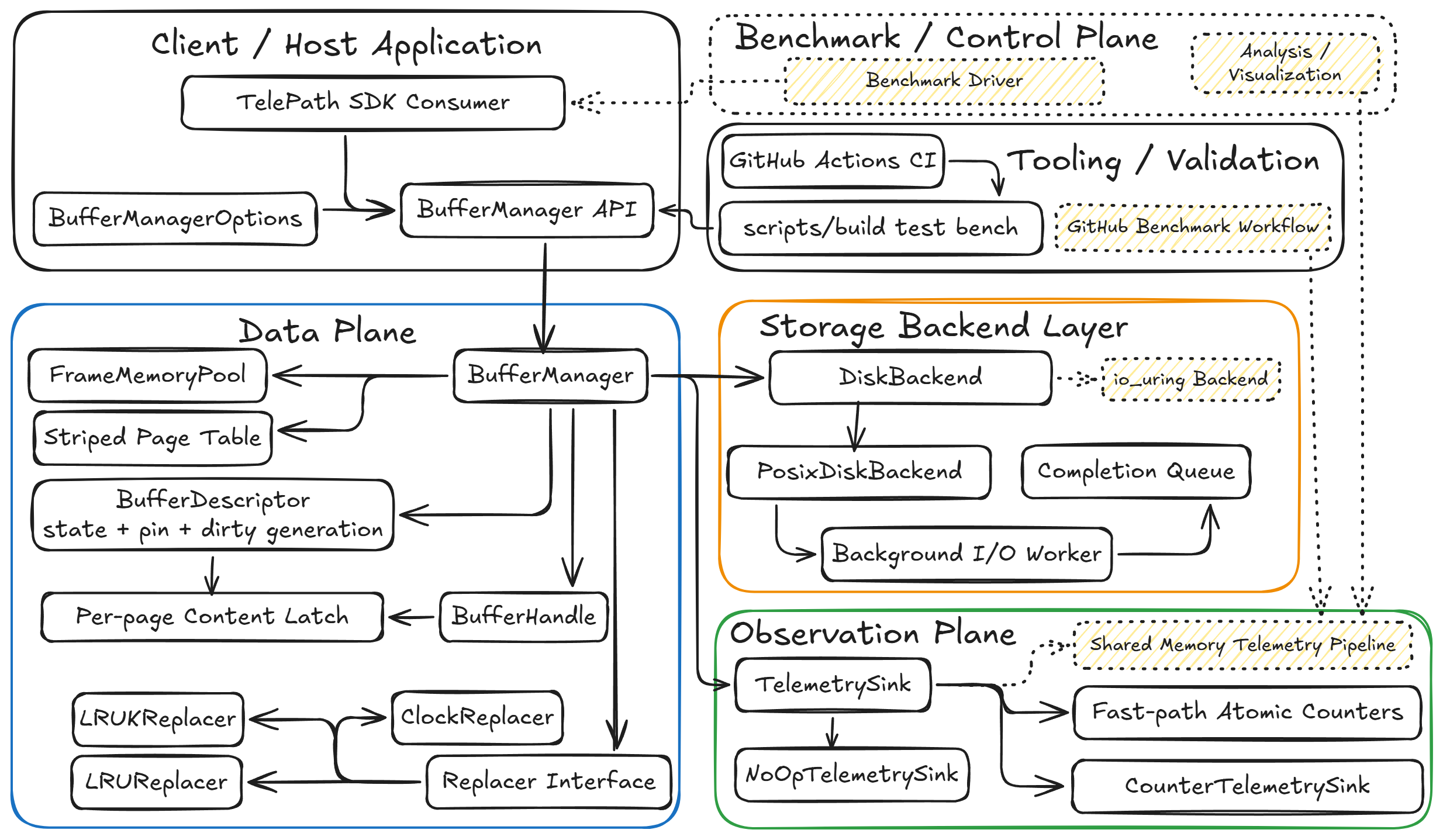
TelePath is being developed with a deliberate split between the data plane and the observation plane so that instrumentation remains part of the architecture rather than an afterthought.
Modern storage devices can expose far more concurrency than traditional teaching-oriented buffer managers were designed to exploit. At the same time, many systems prototypes remain difficult to observe internally without resorting to invasive logging or heavyweight tracing.
TelePath exists to provide a smaller and more auditable experimental base for studying questions such as:
- how a buffer pool scales under increasing thread counts,
- how replacement policy behavior changes under skewed workloads,
- how much observability can be added before it disturbs the data path,
- how an async-ready design should be staged under realistic development constraints such as WSL2.
TelePath currently targets the following system boundary:
- It is a C++ library.
- It manages page-sized blocks in memory and coordinates persistence through a storage backend.
- It exposes observability through telemetry sinks.
- It is designed as a foundation for benchmarking and future experimentation.
TelePath does not currently aim to include:
- SQL parsing,
- query execution,
- B+Tree indexes,
- MVCC or transaction management,
- WAL or crash recovery,
- production-grade monitoring integrations in the first milestone.
The current implementation has moved beyond the original State 1/2 skeleton and now includes a usable State 3 writeback core:
BufferManager,BufferHandle, andBufferDescriptor- contiguous frame memory allocation
DiskBackend,PosixDiskBackend,IoUringDiskBackend, andDiskBackendFactory- miss coordination for concurrent same-page faults
- centralized completion dispatch for submitted disk requests
- asynchronous flush scheduling with worker threads
- foreground/background flush queue separation with configurable batching
- cleaner-backed dirty-page writeback with watermark-driven activation
ClockReplacer,LruReplacer, andLruKReplacer- counter-based and no-op telemetry sinks
- benchmark and CI paths for fallback and native validation
This means TelePath now supports not only the basic buffer lifecycle, but also:
- synchronous external page access on top of internal async-style disk orchestration,
- explicit same-page miss ownership instead of duplicate load work,
- a real writeback path with completion routing and task waiting,
- cleaner-assisted dirty-page management,
- stronger regression coverage around flush correctness, failure handling, and scheduler behavior.
TelePath keeps environment bootstrap scripts under support/ and day-to-day project entry scripts under scripts/.
sudo ./support/install_build_deps.shsudo ./support/install_dev_tools.shThis installs tools such as clang, clang-format, clang-tidy, lldb, and valgrind. These are recommended for development, but they are not required for the minimal build path.
./scripts/build/debug.sh
./scripts/test/debug.sh./scripts/build/asan.sh
./scripts/test/asan.shOn supported native Linux kernels, the dedicated io_uring path can be built and tested separately:
./scripts/build/io_uring_debug.sh
./scripts/test/io_uring_native.shLeakSanitizer support is prepared through:
./scripts/build/lsan.shHowever, LSAN execution may fail in ptrace-constrained or restricted WSL-style environments. That limitation is environmental rather than a known TelePath correctness issue.
The repository structure and ownership rules are documented here:
The main implementation currently lives under:
src/cpp/include/telepathsrc/cpp/libtest/cppsupportscripts
- Phase 1: establish a stable, testable buffer pool skeleton
- Phase 2: strengthen concurrent lifecycle semantics, async-ready I/O boundaries, and benchmark scaffolding
- Phase 3: deliver centralized completion ownership, async writeback scheduling, and cleaner-backed dirty-page management
- Phase 4: continue toward shared-memory telemetry transport, deeper native backend optimization, and larger-scale experimentation
The current implementation is still early-stage. The main focus is architectural correctness, stable interfaces, and controlled extensibility rather than premature performance claims.
Public project documentation lives under docs/.
Recommended entry points:
📜 License
TelePath is Open Source software released under the MIT License.
🎨 Credits
The header illustration is from "テレパシ (Telepathy)", which inspired my project name. All rights reserved by the original artists.