


Walkers is a slippy maps widget for egui, similar to very popular Leaflet, but written in Rust. It compiles to native applications as well as WASM. See the online demo here.
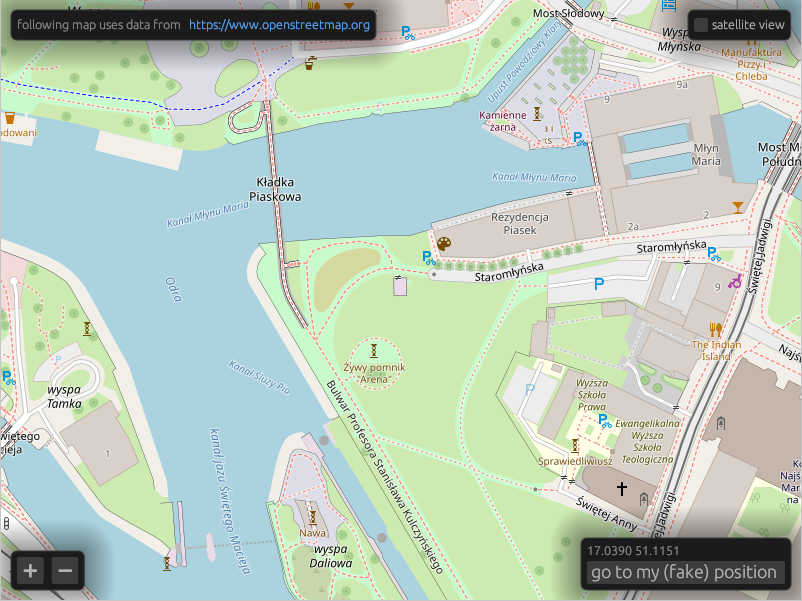
It supports OpenStreetMap, mapbox, and compatible tile servers.
Before deploying your application, please get yourself familiar with the OpenStreetMap usage policy, and consider donating the OpenStreetMap Foundation.
Walkers has three main objects. Tiles downloads images from a tile map provider
such as OpenStreetMap and stores them in a cache, MapMemory keeps track of
the widget's state and Map is the widget itself.
use walkers::{HttpTiles, Map, MapMemory, Position, sources::OpenStreetMap};
use egui::{Context, CentralPanel};
use eframe::{App, Frame};

struct MyApp {
    tiles: HttpTiles,
    map_memory: MapMemory,
}

impl MyApp {
    fn new(egui_ctx: Context) -> Self {
        Self {
            tiles: HttpTiles::new(OpenStreetMap, egui_ctx),
            map_memory: MapMemory::default(),
        }
    }
}

impl App for MyApp {
    fn update(&mut self, ctx: &Context, _frame: &mut Frame) {
        CentralPanel::default().show(ctx, |ui| {
            ui.add(Map::new(
                Some(&mut self.tiles),
                &mut self.map_memory,
                Position::from_lon_lat(17.03664, 51.09916)
            ));
        });
    }
}
You can see a more complete example here.
Walkers suports numerous build options, such as Android and WASM. They all share
a common library - demo, but require a different build workflow, not
necessarily compatible with Cargo alone.
To enable mapbox layers, you need to define MAPBOX_ACCESS_TOKEN environment
variable before building. You can obtain one, by creating a
mapbox account.
cd demo_native
cargo runcd demo_web
trunk serve --releaseYou need to have Android SDK and cargo-ndk installed.
cd demo_android
make run-on-device