
⚠️ Early Development Notice FsPulse is under active development and is not yet feature-complete. Core functionality is stable, but expect continued evolution and occasional breaking changes. Feedback and issue reports are welcome as we work toward a 1.0 release.


📖 FsPulse has comprehensive documentation. Jump straight to the docs →
Read-Only Guarantee. FsPulse never modifies your files. It requires only read access to the directories you configure for scanning. Write access is required only for FsPulse's own database, configuration files, and logs — never for your data.
Local-Only Guarantee. FsPulse makes no outbound network requests. All functionality runs entirely on your local system, with no external dependencies or telemetry.
FsPulse is a comprehensive filesystem monitoring and integrity tool that gives you complete visibility into your critical directories. Track your data as it grows and changes over time, detect unexpected modifications, and catch silent threats like bit rot and corruption before they become disasters. FsPulse provides continuous awareness through automated scanning, historical trend analysis, and intelligent alerting.
Your filesystem is constantly evolving—files are added, modified, and deleted. Storage grows. But invisible problems hide beneath the surface: bit rot silently corrupts data, ransomware alters files while preserving timestamps, and you don't realize directories have bloated.
FsPulse gives you continuous awareness of both the visible and invisible:
Monitor Change & Growth:
- Track directory sizes and growth trends over time
- Visualize file additions, modifications, and deletions
- Understand what's changing and when across all scans
Detect Integrity Issues:
- Content Hashing (SHA2): Catches when file contents change even though metadata stays the same—the signature of bit rot or tampering
- Format Validation: Reads and validates file structures to detect corruption in FLAC, JPEG, PNG, PDF, and more
Whether you're managing storage capacity, tracking project evolution, or ensuring data integrity, FsPulse provides the visibility and peace of mind that comes from truly knowing the state of your data.
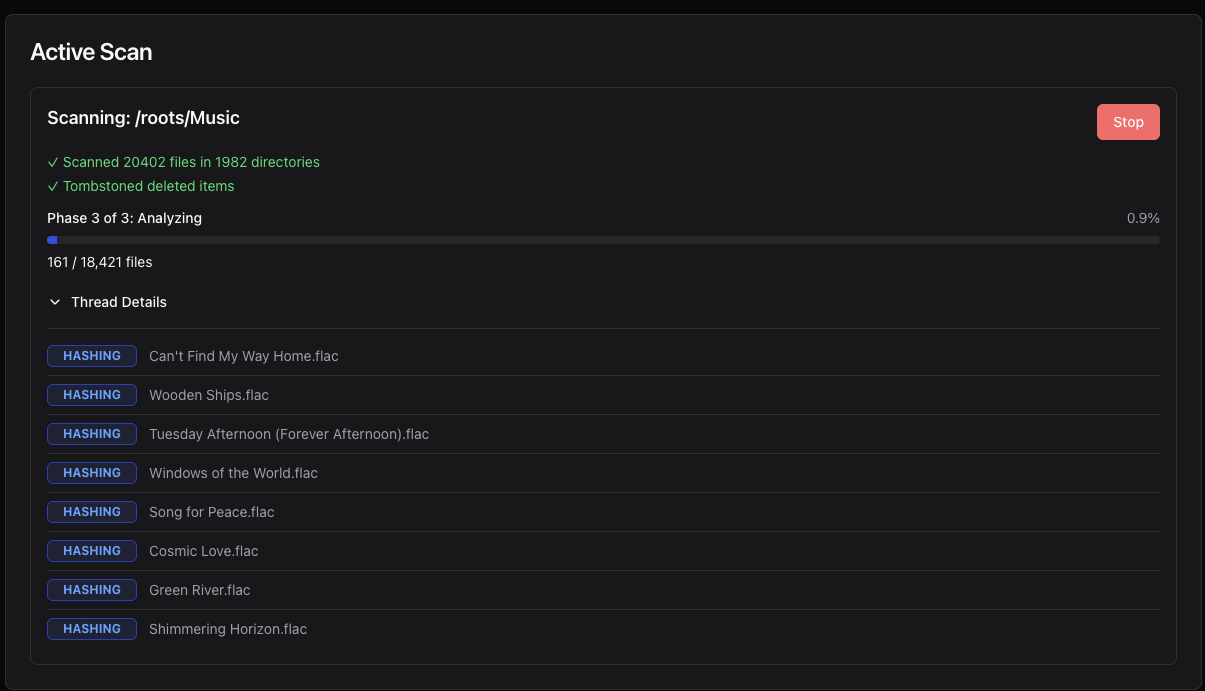
Web UI showing real-time scan progress with live statistics
- Continuous Monitoring — Schedule recurring scans (daily, weekly, monthly, or custom intervals) to track your filesystem automatically
- Size & Growth Tracking — Monitor directory sizes and visualize storage trends over time with dual-format units
- Change Detection — Track all file additions, modifications, and deletions with complete historical records
- Integrity Verification — SHA2 hashing detects bit rot and tampering; format validators catch corruption in supported file types
- Historical Analysis — Interactive trend charts show how your data evolves: sizes, counts, changes, and alerts
- Alert System — Suspicious hash changes and validation failures flagged immediately with status management
- Powerful Query Language — SQL-inspired syntax for filtering, sorting, and analyzing your filesystem data
- Web-First Design — Elegant web UI for all operations including scanning, browsing, querying, and configuration
Quick start instructions are below, but full documentation is available in book form:
Key sections:
- Getting Started — Installation, Docker deployment, and first steps
- Interface — Complete guide to Monitor, Browse, Insights, Alerts, and Explore pages
- Scanning Concepts — How scans work, hashing, and validation
- Query Syntax — Powerful filtering and data exploration
- Configuration — Customizing FsPulse behavior
docker run -d \
  --name fspulse \
  -p 8080:8080 \
  -v fspulse-data:/data \
  -v ~/Documents:/roots/documents:ro \
  gtunesdev/fspulse:latest
Access the web UI at http://localhost:8080
The Docker Deployment Guide provides complete coverage including Docker Compose examples, NAS deployments, and detailed configuration options.
Start the FsPulse server:
fspulseOr explicitly:
fspulse serveOpen http://127.0.0.1:8080 in your browser to access the web interface.
All functionality is available through the web UI:
- Configure and manage scan roots
- Schedule automatic scans
- Monitor scan progress in real-time
- Browse your filesystem hierarchy
- Query and explore your data
- Manage alerts and validation issues
FsPulse is configured through environment variables or a config file:
# Example: Change port and enable debug logging
export FSPULSE_SERVER_PORT=9090
export FSPULSE_LOGGING_FSPULSE=debug
fspulse
See the Configuration Guide for all available settings.
The interface provides powerful visual tools for monitoring and exploring your data:
- Monitor — Configure automatic scans with flexible scheduling options, view execution queue status, and manage scan roots
- Live Scan Progress — Watch scan activity in real-time whether manually initiated or scheduled, with detailed phase-by-phase statistics
- Browse with Detail View — Explore your filesystem hierarchy with elegant sliding panels showing item metadata, validation status, alerts, and complete change history
- Insights — Interactive charts tracking file sizes, counts, change activity, and validation issues over time with customizable date ranges
- Alert Management — Filter, flag, and dismiss integrity issues with context-aware views and status tracking
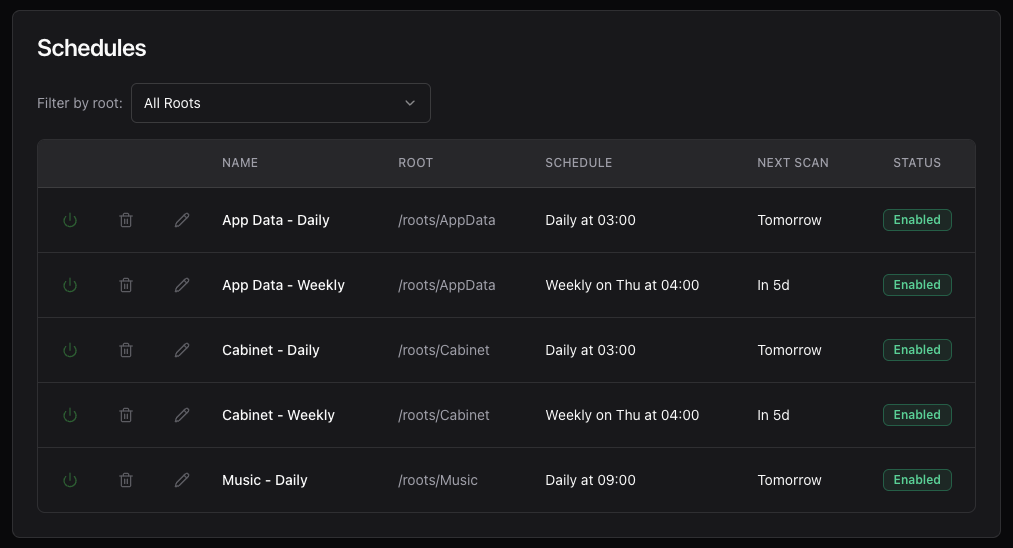
Monitor page showing scheduled scans and queue management
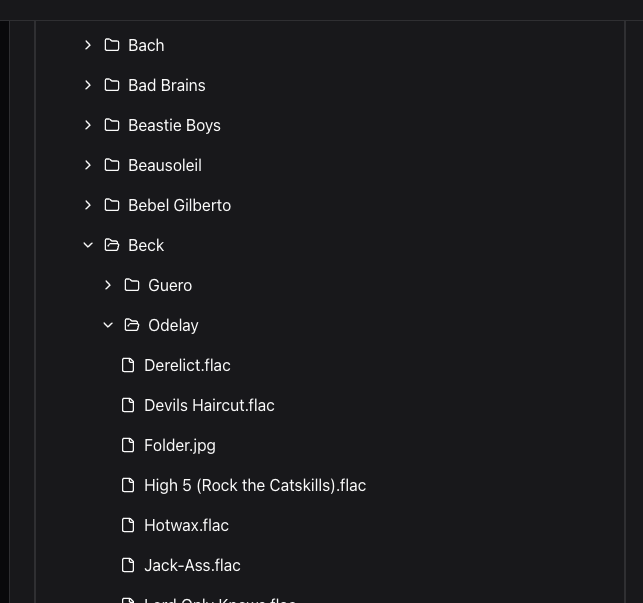
Browse page showing filesystem hierarchy navigation
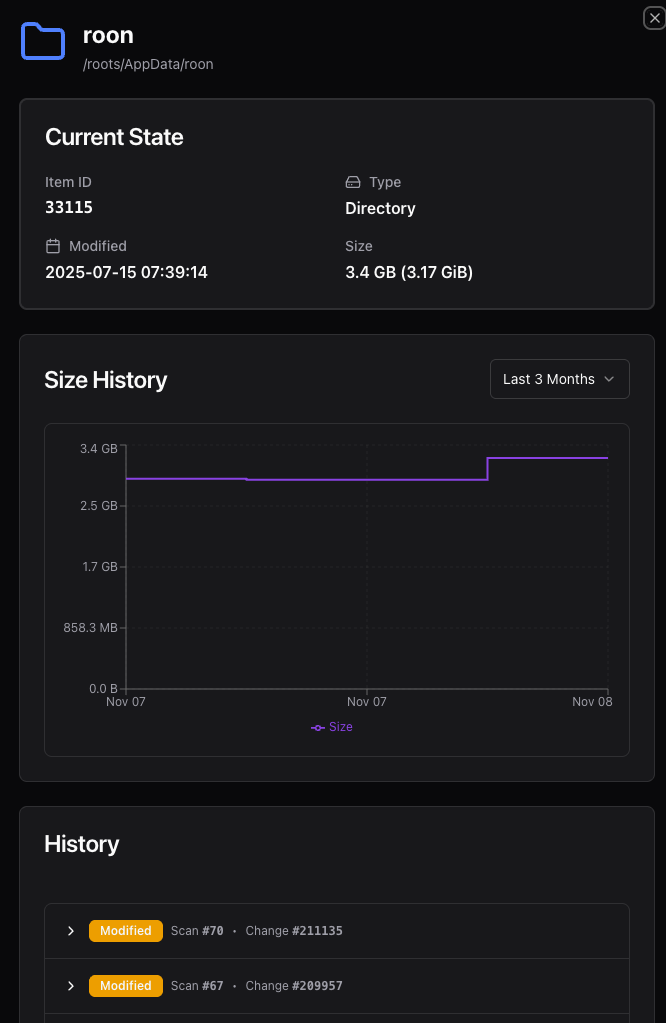
Item detail panel showing metadata, validation status, and change history
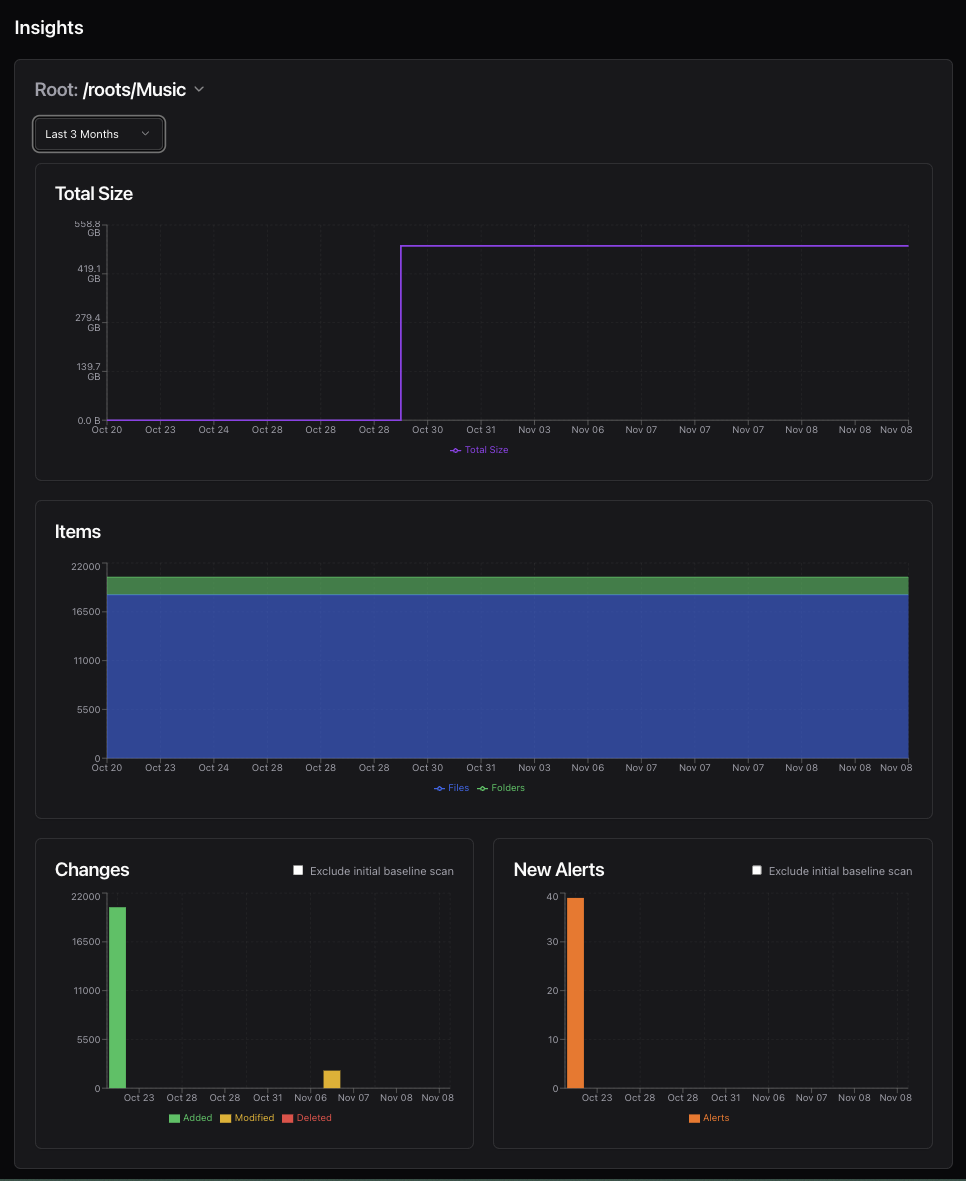
Insights page with interactive charts for historical trend analysis
FsPulse can be installed in several ways depending on your preferences and environment:
Pull the official image and run:
docker pull gtunesdev/fspulse:latest
docker run -d --name fspulse -p 8080:8080 -v fspulse-data:/data gtunesdev/fspulse:latest
Multi-architecture support: linux/amd64, linux/arm64
See the Docker Deployment Guide for complete instructions.
Install via Rust's package manager:
cargo install fspulseRequires Rust toolchain installed on your system.
Download platform-specific binaries from GitHub Releases.
Available for: Linux, macOS, Windows
macOS builds include both Intel (x86_64) and Apple Silicon (ARM64) binaries.
Note: All web UI assets are embedded in the binary—no external files or dependencies required.
Clone the repository and use the build script:
git clone https://github.com/gtunes-dev/fspulse.git
cd fspulse
./scripts/build.sh
./target/release/fspulse --help
Prerequisites: Node.js (with npm) and Rust (via rustup) must be installed.
See the Building from Source Guide for detailed build instructions including manual steps and troubleshooting.
- Report issues: GitHub Issues
- Documentation: FsPulse Book
- Docker Hub: gtunesdev/fspulse
FsPulse is under active development, but is not currently accepting external contributions. This may change in the future — see our Development Guide for details.
Released under the MIT License. See LICENSE for details.